
 Login
Login 

Scheduling
Scheduler power tools — filters, teams, and tracking missed work with reason codes
By Humanz · 2026-06-12
Scheduler power tools — filters, teams, and tracking missed work with reason codes
Once a workforce schedule passes a few dozen people across multiple clients and sites, the limiting factor stops being data entry and becomes finding things. Which shifts are still unfilled for Client A next week? Where are all the boilermakers? And the question most businesses can’t answer at all: how much work did we turn away last quarter, and why?
This article covers three features of the Humanz rostering and scheduling platform that answer those questions: layered filtering, custom team views, and reason codes for unallocated shifts.
1. Filters — two layers, from quick search to forensic
The scheduler has two filtering layers, and knowing which to reach for saves real time.
The top-left search box is the quick layer. It matches against:
- Resource names — find a person fast
- Job names — shows matching jobs plus other jobs assigned to the same resources, which is deliberately clever: you see potential clashes before you create an overlap
- Trade (job position) — filters by the trade the job position requires (note: not the resource’s own trade)
The Filters panel is the forensic layer. It splits into shift filters (job, client, site, manager, shift status, shift type, position trade) and resource filters (resource type, resource trade/profession, qualifications, induction, teams). To search by a worker’s trade rather than the job’s, this is the place. Two usability details worth knowing: you can pin the panel open to the left or right side of the screen while you work, and a single reset clears everything. There’s also an option to include unallocated shifts in a job-filtered view — essential when you’re checking whether a job is fully crewed.
2. Teams — arrange the schedule the way you think
Teams in Humanz are a visual grouping layer for the schedule — they have no link to clients, jobs, or trades, and workers can’t see what team they’re in. That’s a feature, not a limitation: it means you can organise the Gantt view however your planners think (Leadership, A Panel, Boilermakers, Adhoc Fitters) without touching any operational data.
Key mechanics:
- Create teams and add users from Team Manage on the schedule; a person can sit in multiple teams at once
- Drag to reorder members within a team, and drag teams to reorder them on the schedule page
- Removing someone from a team doesn’t remove them from the app
- Assets get teams too — manage asset teams from the My Assets page the same way, so vehicles, cranes, and rooms group logically on the schedule
If you track plant and equipment alongside people — covered in our piece on asset tracking for field teams — asset teams keep the resource rows organised instead of one long undifferentiated list.
3. Reason codes — turn unfilled shifts into business intelligence
This is the quiet star of the three. Every unallocated shift is a story: no accommodation available, client cancelled, no one with the right ticket free. Most businesses lose those stories the moment the week rolls over — which means labour planning, recruitment, and camp negotiations run on gut feel.
Humanz lets you code unallocated shifts with a reason and report on them:
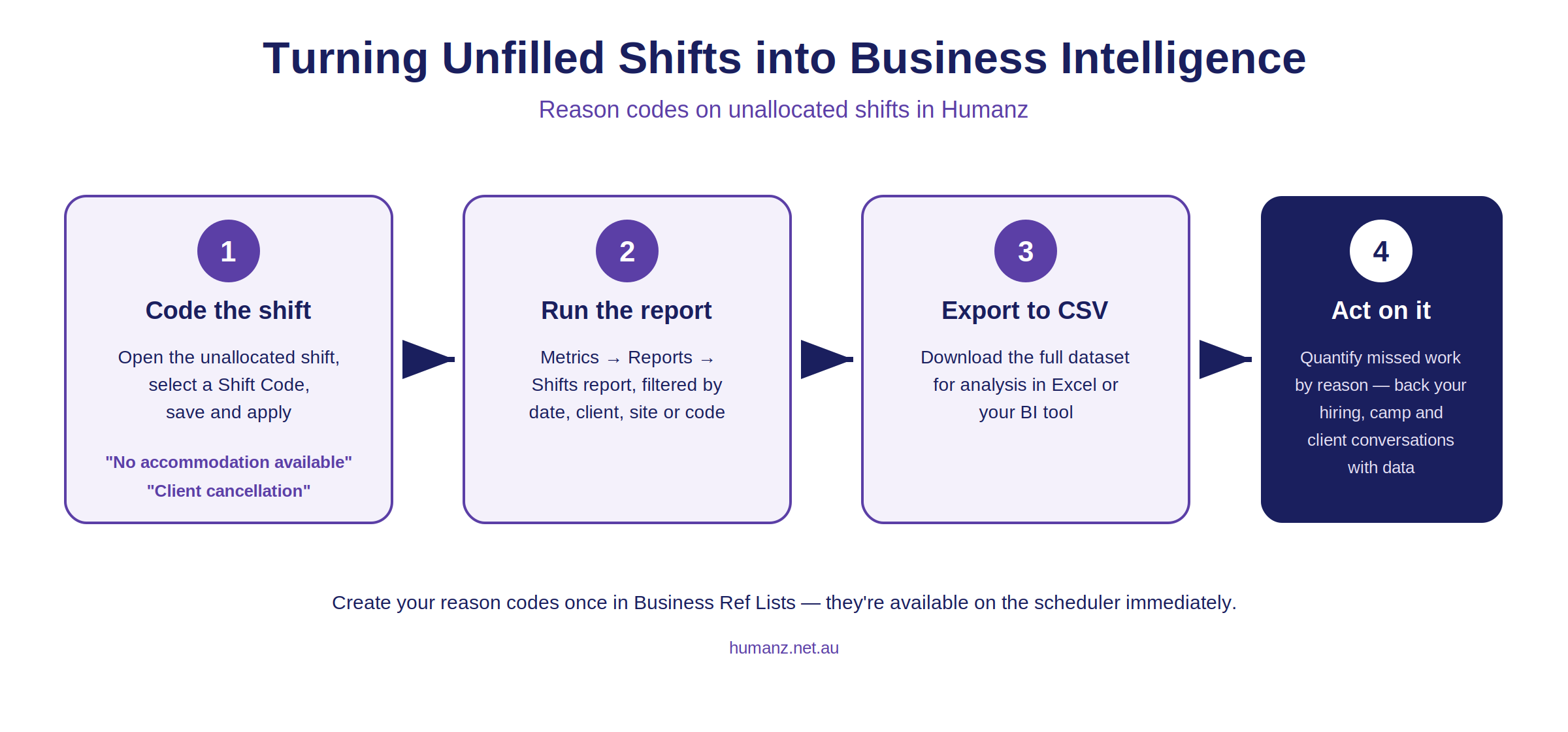
- Create your codes in Business Ref Lists — e.g. No accommodation available, Client cancellation, Unable to supply
- Code the shift — open the unallocated shift, pick the shift code, save and apply
- Report — in Metrics → Reports, run the shifts report filtered to what you’re investigating
- Export to CSV and analyse: missed shifts by reason, client, site, trade, or month
After a quarter of consistent coding, you can put numbers on questions like “how many shifts did we decline because of camp beds?” — which is exactly the evidence you want when negotiating accommodation allocations or making a hiring case. It’s the same discipline that makes digital timesheets valuable: capture the data at the moment it happens, and reporting becomes free. The cleaner that scheduling data is, the more you can lean on automatic scheduling and auto-rostering to build the bulk of the roster for you and reserve the manual effort for the genuinely hard calls.
There’s a compliance dividend too. Structured records of scheduling decisions sit comfortably alongside the record-keeping obligations employers carry under the Fair Work system, and labour utilisation data is increasingly what bodies like Master Builders Australia point to when builders are asked to evidence capacity. For broader context on what records a field business should keep digitally, the ATO’s record-keeping guidance for business is the baseline.
Small features, compounding payoff
None of these three features is glamorous. But together they change what the scheduler is: from a place where shifts get placed, to a system you can interrogate. That’s the practical difference between a calendar and genuine workforce management software Australian field businesses can run on — and why scheduler depth should be high on the checklist when evaluating any rostering software for trades and field teams.
Frequently asked questions
Do workers see what team they’re in? No. Teams are a schedule-view grouping for planners only, with no link to clients, jobs, or trades.
What’s the difference between trade in the search box and trade in the filter panel? The top-left search matches the trade assigned to the job position; the Filters panel lets you filter by the resource’s trade or profession.
Can I report on coded shifts by client or site? Yes. The shifts report in Metrics can be filtered, and the CSV export lets you slice missed shifts by reason, client, site, trade, or period in a spreadsheet.
When are new reason codes available? Immediately after you add them in Business Ref Lists — refresh your browser when you leave that page and the code is ready to use.
Want to see what your business is turning away? Book a demo and we’ll set up your reason codes and run the first report with you.
Ready to see Humanz on your own roster?
Free 30-minute walkthrough — we'll use your real crews, sites and shift patterns.