
 Login
Login 

Guides
Construction Site Compliance Checklist (Australia): What to Track and Automate
By Humanz · 2026-06-08
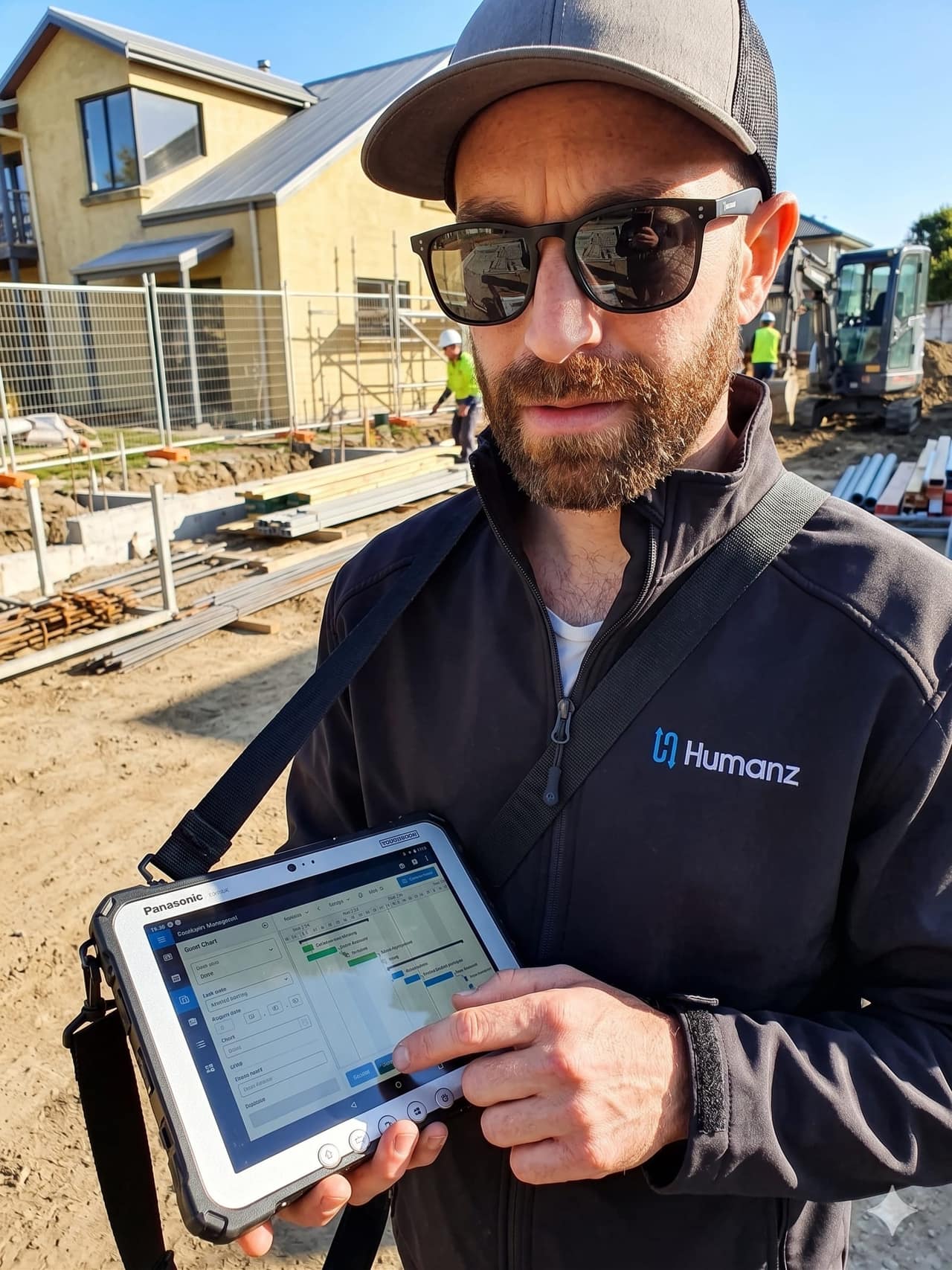
Construction site compliance in Australia isn’t a single thing — it’s a layered set of obligations that spans safety, licensing, employment law, and incident reporting. For site managers already stretched thin, keeping across all of it manually is a recipe for missed checks, expired credentials, and real legal exposure.
This article breaks down what construction site compliance actually covers, what Australian law requires, and what your workforce software should be tracking automatically — so you don’t have to.
What does construction site compliance cover?
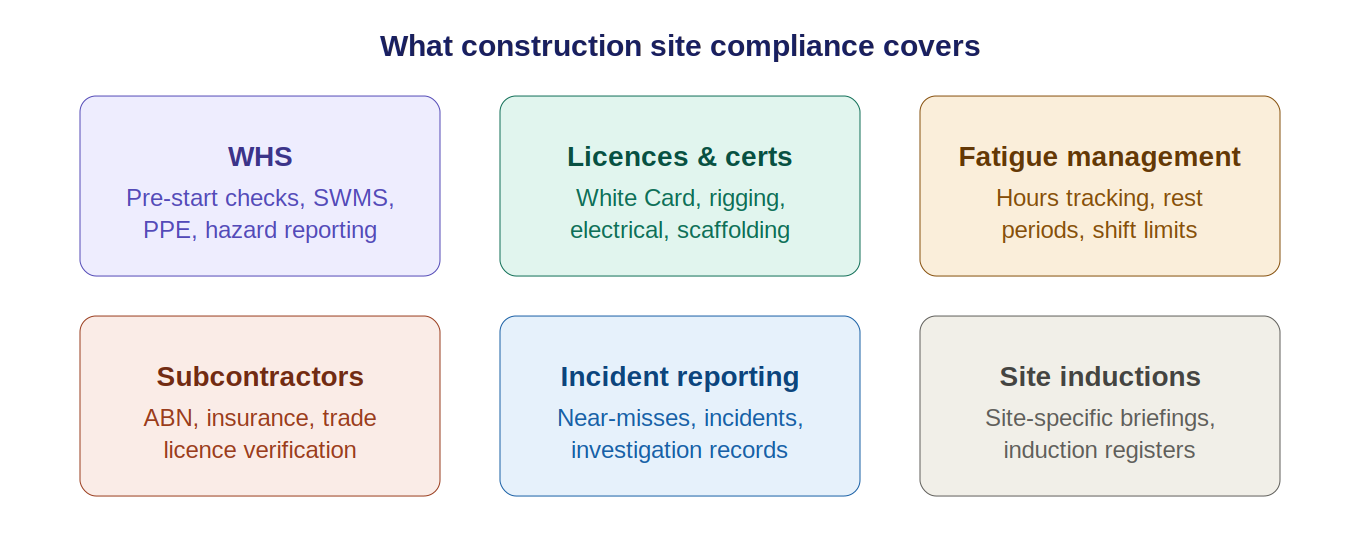
Construction compliance in Australia spans several distinct areas:
- WHS (Work Health and Safety) — pre-start checks, hazard identification, safe work method statements (SWMS), PPE requirements
- Worker licences and certifications — ensuring every worker on site holds current, valid tickets for their role
- Fatigue management — tracking hours worked and enforcing rest period requirements
- Subcontractor compliance — verifying insurance, ABN, and trade licences for all contractors
- Incident and near-miss reporting — capturing and storing records in a format that satisfies regulators
- Site inductions — ensuring every worker has completed a site-specific induction before starting work
- Fair Work Act obligations — rest periods, break entitlements, overtime records
Each of these has its own regulatory framework, and non-compliance in any one area can result in fines, project shutdowns, or worse.
The Australian compliance landscape
WHS obligations
Under the Work Health and Safety Act (adopted across most Australian states and territories), construction businesses have a primary duty of care to ensure workers aren’t exposed to health and safety risks.
Key requirements for construction sites include:
- Daily pre-start checks documented for plant and equipment
- Safe work method statements for high-risk construction work
- Current induction records for all site personnel
- A compliant incident reporting system with defined investigation and notification timelines
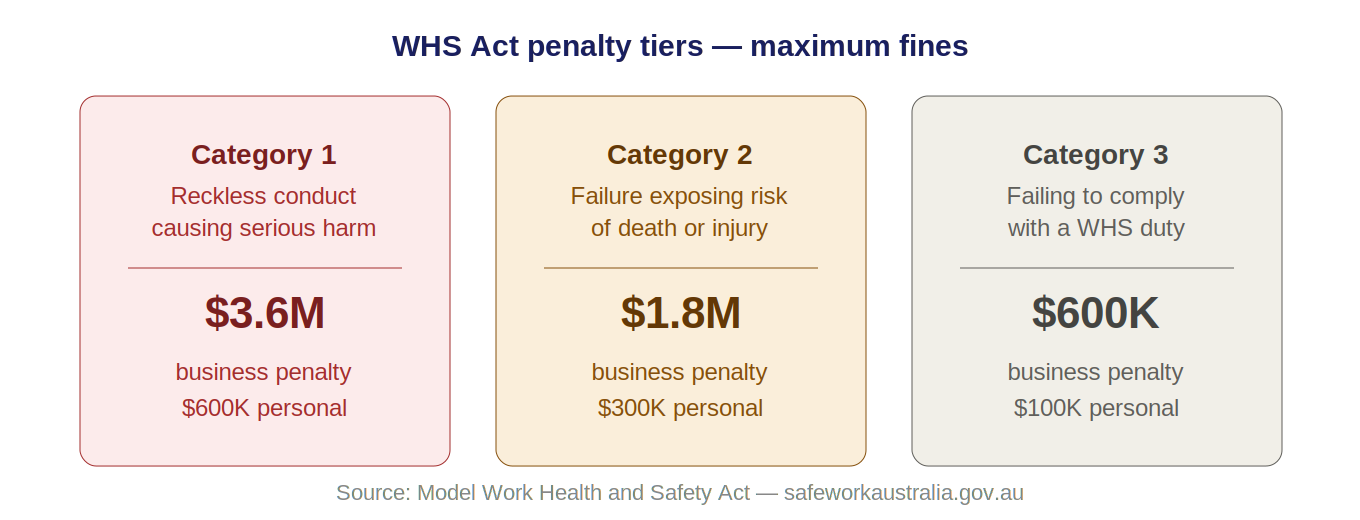
Safe Work Australia provides the model codes of practice that define what ‘reasonably practicable’ looks like for construction businesses. Breaches can attract penalties of up to $3.6 million for businesses and $600,000 personally for officers.
Licence and certification requirements
In Australia, construction roles with specific licensing requirements include:
- Dogging, rigging, and crane operation (nationally recognised licences)
- Scaffolding (basic, intermediate, advanced)
- Explosive power tools
- Asbestos removal
- Electrical work (state-specific licensing)
- Construction induction card (White Card) — mandatory for all site personnel
Note: Licence requirements vary by state and territory. A Queensland electrical licence is not automatically valid in WA. Always verify the applicable jurisdiction for your site.
Comcare’s guidance on workplace compliance covers fatigue as a workplace hazard that must be actively managed — particularly relevant for construction businesses running extended shifts or FIFO arrangements. See our dedicated guide on fatigue management software Australia for a full breakdown.
The compliance checklist — what to track on every site
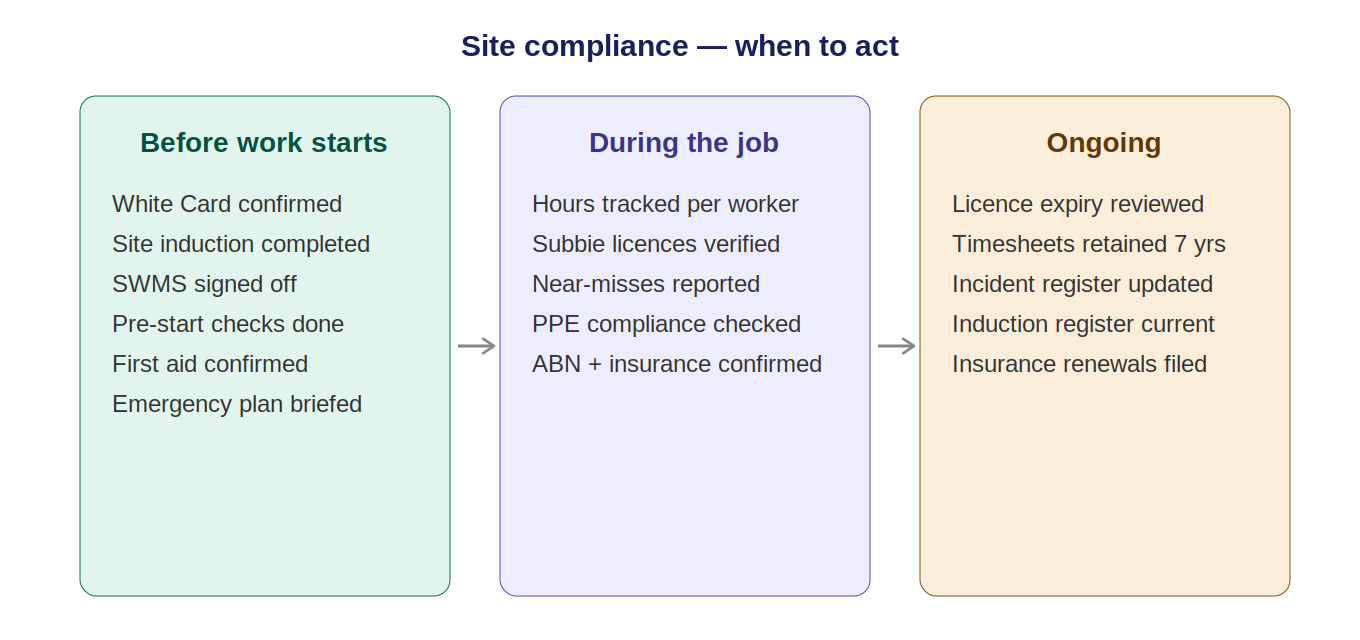
Before work starts
- [ ] All workers hold a current White Card (Construction Induction Card)
- [ ] Site-specific induction completed and recorded for every worker
- [ ] SWMS reviewed and signed off for all high-risk work activities
- [ ] Plant and equipment pre-start checks completed and documented
- [ ] First aid provisions confirmed — first aider on site, kit stocked and accessible
- [ ] Emergency procedures briefed to all site personnel
During the job
- [ ] Hours tracked per worker — fatigue thresholds monitored
- [ ] Subcontractor licences and insurance verified before work commences
- [ ] Near-misses and incidents reported and recorded as they occur (not retrospectively)
- [ ] PPE compliance enforced and documented
- [ ] Contractor ABN and insurance currency confirmed
Ongoing (weekly/monthly)
- [ ] Licence and certification expiry dates reviewed — alerts sent for upcoming renewals
- [ ] Timesheet records verified and retained per Fair Work requirements (7 years)
- [ ] Incident register reviewed and submitted to regulator where required
- [ ] Induction register up to date for all current site personnel
- [ ] Subcontractor public liability insurance renewed and on file
For businesses managing a mix of direct employees and contractors, subcontractor management software can consolidate licence tracking, insurance currency, and ABN verification in one place — rather than managing it across spreadsheets and emails.
What your compliance software should automate
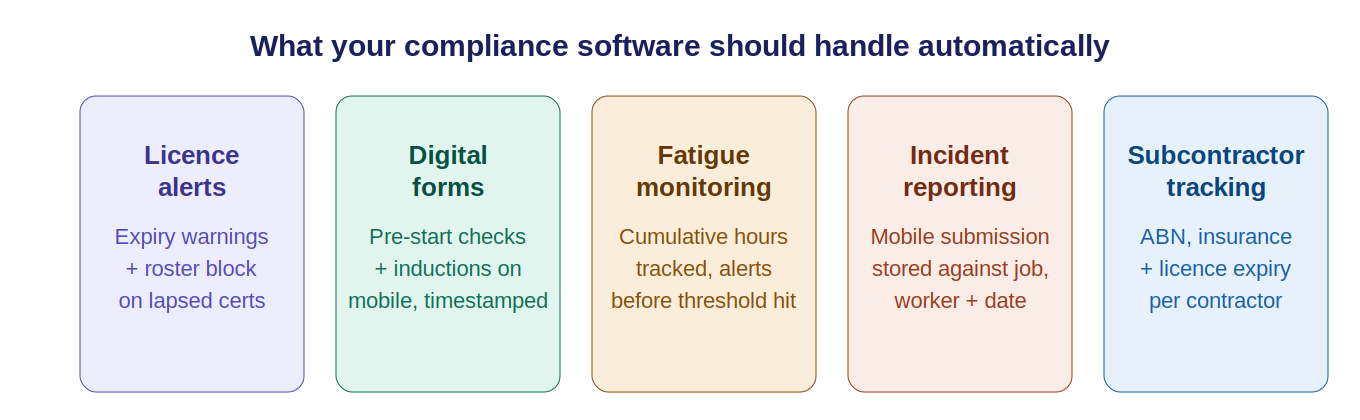
Manual compliance management — spreadsheets, paper forms, email reminders — doesn’t scale and doesn’t produce audit-ready records. Here’s what purpose-built software should be handling:
Licence and certification expiry alerts
The software should track every worker’s credentials and send proactive alerts — to both the manager and the worker — when a licence is approaching expiry. Critically, it should also block rostering of workers whose credentials have lapsed.
Digital pre-start and induction forms
Pre-built or customisable digital forms that workers complete on mobile before starting work. Submissions are timestamped, geotagged, and stored automatically — creating an audit trail without any filing. A flexible digital form builder for field teams lets you replicate any paper form you currently use, from SWMS sign-offs to toolbox talks.
Fatigue threshold monitoring
The system should track cumulative hours worked across shifts and alert when a worker is approaching or has exceeded safe work thresholds. This is especially important for sites running extended shifts or overnight work.
Incident reporting
Workers and supervisors should be able to submit incident or near-miss reports from their mobile, with the report automatically stored against the job, date, worker, and site. No paper forms, no data entry delays.
Subcontractor compliance tracking
A contractor’s profile should include their ABN, trade licences, insurance details, and expiry dates — all visible to the manager, with alerts when anything lapses. This is exactly what a dedicated subcontractor management platform handles automatically.
How Humanz handles compliance for field teams
Humanz is a workforce management platform with site compliance built in, designed specifically for Australian field and construction teams. The digital forms builder lets businesses create pre-start checks, induction forms, incident reports, and any other compliance documentation — completed by workers on mobile, stored against their record with timestamps.
Key compliance features in Humanz:
- Digital forms — create and deploy any form to workers on mobile; submissions stored automatically
- Licence and cert tracking — expiry alerts for every worker’s credentials; blocks rostering when expired
- Fatigue monitoring — hours-worked alerts based on configurable thresholds
- Subcontractor profiles — licence, insurance, and ABN tracked against each contractor
- Full audit trail — every form submission, timesheet, and approval is timestamped and retrievable
Timesheet accuracy underpins everything here — if hours aren’t being captured correctly, fatigue alerts won’t fire at the right time. Our article on digital timesheets for tradies covers how to get that foundation right.
Frequently asked questions
What is the penalty for WHS non-compliance in Australia?
Penalties under the model WHS Act vary by severity. A Category 1 offence (reckless conduct causing serious harm) can attract fines of up to $3.6 million for businesses. Category 2 (failure to comply with duty exposing someone to risk of death or serious injury) up to $1.8 million. Even Category 3 breaches (failing to comply with a WHS duty) can reach $600,000.
Do digital compliance records satisfy Australian regulators?
Yes. Australian WHS regulators accept digital records, provided they are accurate, complete, and accessible. In many cases digital records are more defensible than paper records because they include timestamps, user IDs, and GPS data that paper cannot provide.
How long do I need to keep compliance records?
This depends on the type of record. Fair Work Act timesheet records must be kept for 7 years. WHS incident records: generally 5 years from the date of the incident (varies by jurisdiction). Induction records: recommended to keep for the duration of the project plus 7 years. When in doubt, retain longer.
Do subcontractors need a White Card?
Yes. The White Card (Construction Induction Card) is required for any person who carries out construction work in Australia, including subcontractors, labour hire workers, and self-employed tradespeople. There is no exemption based on employment status.
Can one app handle all of this compliance tracking?
Purpose-built field workforce platforms like Humanz are designed to consolidate forms, licences, timesheets, fatigue tracking, and subcontractor management in one place. Generic HR platforms typically cover only part of the picture — which is why construction-specific tools are worth considering.
Related articles
Ready to see Humanz on your own roster?
Free 30-minute walkthrough — we'll use your real crews, sites and shift patterns.