
 Login
Login 

Guides
Best workforce management software in Australia — 2026 buyer's guide
By Humanz · 2026-06-20
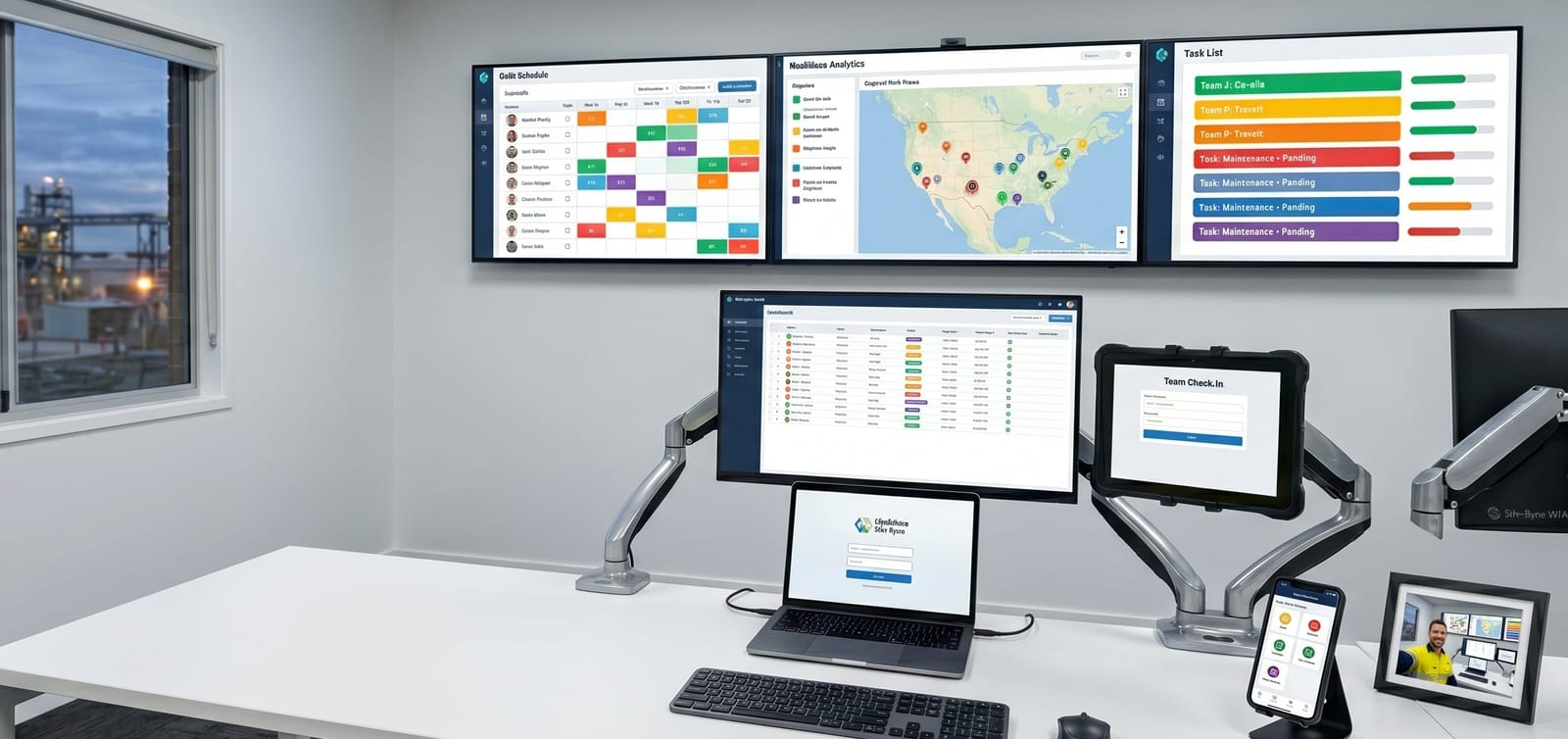
Workforce management software has become a genuine operational necessity for most Australian businesses managing more than a handful of workers. The question is no longer whether to use a platform — it’s which one to choose.
The market has matured considerably. There are now purpose-built platforms for specific industries, mobile-first tools for field teams, and integrated suites that combine HR, payroll, and workforce management in a single system. The range of options is genuinely useful, but it also makes the buying decision more complex. Many businesses begin their search by weighing up alternatives to Deputy and Tanda, particularly when those hospitality- and retail-first tools don’t fit a field-based or trades workforce.
This guide covers what workforce management software actually does, what Australian businesses specifically need to account for, the warning signs that your current system isn’t working, and the right questions to ask when evaluating any platform.
What is workforce management software?
Workforce management (WFM) software is a category of business tools that helps organisations plan, schedule, track, and manage their workforce. At its core, it covers:
- Rostering and scheduling — building rosters, assigning workers to shifts or jobs, managing availability and conflicts
- Time and attendance — tracking when workers clock on and off, recording actual hours worked
- Leave management — tracking leave requests, approvals, and balances
- Compliance — ensuring scheduling and pay decisions comply with applicable Awards, legislation, and workplace policies
- Communication — connecting managers and workers around shift information, changes, and operational updates
More comprehensive platforms extend into digital forms, asset management, fatigue monitoring, onboarding, subcontractor management, and payroll integration.
The Australian compliance context — why it matters for your software choice
Choosing workforce management software in Australia is different from choosing it in other markets, because the compliance obligations are substantially more complex. Any platform you evaluate needs to account for the following:
Modern Awards and the Fair Work Act
Australia’s Modern Award system, administered by the Fair Work Commission, covers over 120 industry and occupation awards. Each award specifies minimum rates, overtime provisions, penalty rates, rest break requirements, and allowances. A platform that doesn’t account for this complexity — or that requires significant manual configuration to handle it — is creating ongoing compliance risk.
The Fair Work Ombudsman recovered over $500 million in underpayments in a recent reporting period. Incorrect award interpretation, particularly for shift and overtime calculations, is one of the most common causes. For businesses managing shift workers, our article on Fair Work compliance for shift workers covers the specific obligations in detail.
WHS obligations
Under the model Work Health and Safety Act — adopted across most Australian states and territories and overseen by Safe Work Australia — employers have a primary duty of care that extends to workforce scheduling. Fatigue, understaffing, and inadequate induction are all workplace hazards that an employer is legally obligated to manage.
WorkSafe WA and equivalent state regulators have broad inspection and enforcement powers. Businesses that cannot produce documented evidence of safety controls — including fatigue monitoring, induction records, and incident reporting — are exposed to significant penalties.
ATO and STP reporting
The ATO’s Single Touch Payroll (STP) framework requires payroll data to be reported to the ATO every pay cycle. The accuracy of that reporting depends on the quality of your underlying time and attendance records. A workforce management platform that produces clean, accurate timesheet data is a tax compliance asset, not just an operational one.
State-based variations
Compliance obligations vary by state. Western Australia, for instance, has its own industrial relations system that applies to some employers — the Western Australian Industrial Relations Commission administers these. Long service leave legislation also varies by state, as does the administration of portable long service leave schemes in the construction industry.
A platform built for and by Australians — rather than adapted from a US or European product — is more likely to reflect these nuances out of the box.
Warning signs your current system isn’t working
Before evaluating new platforms, it’s worth diagnosing exactly where your current system is failing. Here are the most common warning signs:
Timesheet problems:
- Supervisors are spending hours every week manually compiling and correcting timesheets
- Payroll disputes are common because workers and managers have different records of hours worked
- You can’t quickly produce a 7-year timesheet history if asked — the records are incomplete or scattered
Rostering problems:
- No-shows happen regularly because shift confirmations are informal or non-existent
- Double-booking of workers or subcontractors occurs more than once a month
- Roster changes are communicated via WhatsApp or text — with no audit trail and no confirmation
Compliance problems:
- You don’t have a live view of which workers have current licences and which have lapsed
- Site induction records are paper-based and stored in a filing cabinet (or don’t exist at all)
- A Fair Work or WHS audit would require significant scrambling to produce the required records
Communication problems:
- Critical safety updates are sent via personal WhatsApp groups with no record of who read them
- Workers regularly show up to the wrong site or at the wrong time
- Subcontractors are briefed verbally with no documented record of what was communicated
If several of these apply, the case for a purpose-built platform is strong — and the cost of not acting is measurable.
Industry-specific requirements — what your sector needs
Workforce management needs vary significantly by industry. A platform that works well for one sector may fall short for another.
Construction and trades
The most demanding use case in the Australian market. Requirements include fatigue monitoring, subcontractor management with licence and insurance tracking, digital forms for pre-start checks and inductions, asset tracking, mobile-first with offline capability, and multi-site rostering. Master Builders Australia and the HIA both publish operational guidance for construction businesses that informs what compliant workforce management looks like in practice.
For a detailed breakdown, see our article on workforce management software for construction.
Mining and resources
FIFO roster management, extended swing compliance, fatigue risk management systems, and principal contractor reporting requirements. The Department of Mines, Industry Regulation and Safety (DMIRS) in WA publishes specific guidance for mining operations that goes beyond the general WHS framework.
Logistics and transport
Driver fatigue management under the Heavy Vehicle National Law (HVNL), depot and field worker rostering, and integration with vehicle telematics systems.
Field services and utilities
Multi-site scheduling, asset allocation, and compliance with industry-specific licencing requirements (electrical, gas fitting, plumbing).
The right questions to ask when evaluating any platform
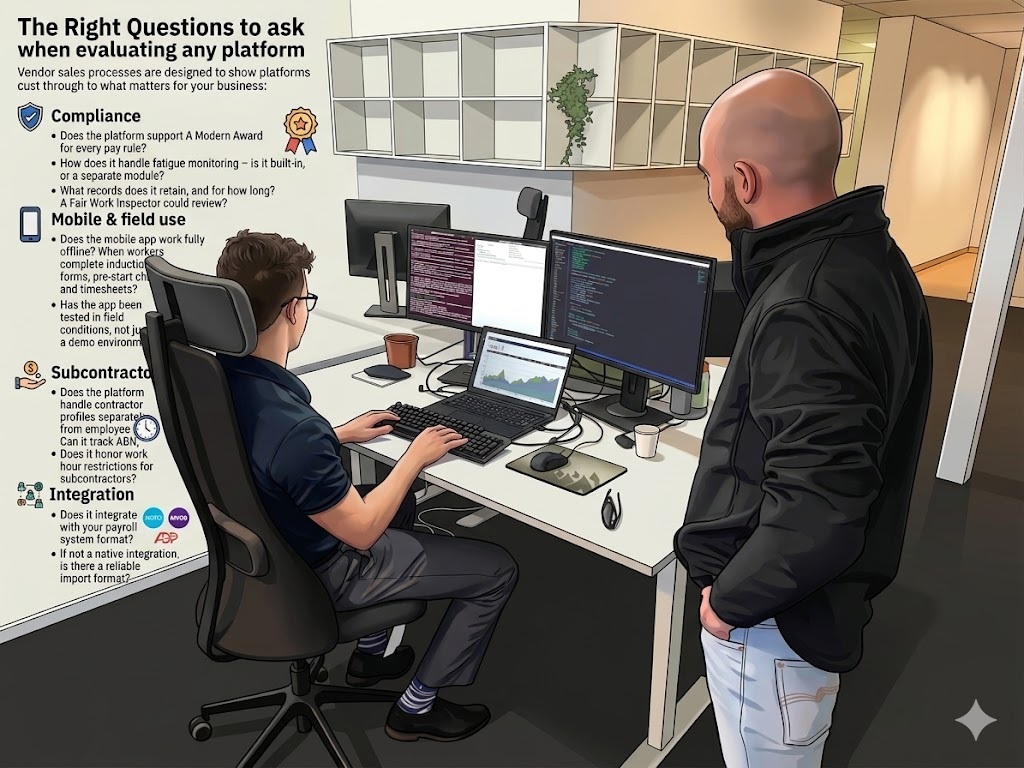
Vendor sales processes are designed to show platforms in their best light. These questions cut through to what matters for your business:
On compliance:
- Does the platform support Australian Modern Award complexity, or does it require manual configuration for every pay rule?
- How does it handle fatigue monitoring — is it built in, or a separate module?
- What records does it retain, and for how long? Can those records be exported in a format a Fair Work Inspector could review?
On mobile and field use:
- Does the mobile app work fully offline? What happens when a worker loses signal on a remote site?
- Can workers complete induction forms, pre-start checks, and timesheets entirely from their phone?
- Has the app been tested in field conditions — not just in a demo environment?
On subcontractors:
- Does the platform handle contractor profiles separately from employee profiles?
- Can it track ABN, trade licences, and public liability insurance with expiry alerts?
- Does it block scheduling of a contractor whose credentials have lapsed?
On implementation and support:
- Where is the support team based? What are their hours?
- What does data migration look like — can you bring existing worker profiles, timesheets, and asset records across?
- What does the implementation timeline look like for a business of your size?
On integration:
- Does it integrate with your payroll system (Xero, MYOB, ADP, KeyPay)?
- If not a native integration, is there a reliable export format?
- What happens when you add a new site or project — does the system scale without significant reconfiguration?
The Australian Institute of Project Management (AIPM) recommends treating software selection with the same rigour as any other capital investment — a structured evaluation against your specific requirements, not just a demo from a sales team.
How to evaluate based on your workforce type
Different workforce compositions require different platform priorities.
If you manage a field-based workforce with subcontractors: Prioritise offline mobile capability, subcontractor compliance tracking, fatigue monitoring, and digital forms. These are non-negotiable for construction, mining services, and field trades. Generic scheduling tools designed for hospitality or retail typically don’t cover these adequately.
If your primary challenge is award compliance and payroll accuracy: Prioritise platforms with strong Modern Award interpretation engines and deep integration with your payroll system. This is the priority for hospitality, retail, and healthcare businesses.
If you’re a small business (under 20 workers) just getting started: Start with a platform that is simple to implement and has a reasonable entry price point, but check that it can scale as you grow — migrating data between platforms is painful.
If you’re an enterprise (500+ workers): Prioritise platforms that offer full HCM capability alongside workforce scheduling, with enterprise-grade security and support SLAs.
How Humanz approaches workforce management for Australian field teams
Humanz is an Australian-built workforce management platform designed specifically for trades, construction, mining support, and field-based teams. It was built by a team with direct experience in the industries it serves — not adapted from a platform designed for a different market.
The platform covers the full operational picture for field and construction businesses:
- Multi-site rostering with live visibility across all projects and crews
- Fatigue monitoring built into the scheduling engine — not a separate module
- Subcontractor management with ABN, licence, and insurance tracking and expiry alerts
- Digital forms for pre-start checks, inductions, and incident reports — completed on mobile, stored with timestamps
- Asset tracking integrated with shift scheduling — allocate plant and equipment alongside workers
- Timesheet management pre-filled from roster data, approved by supervisors, retained for 7 years
- In-app messaging tied to specific jobs with read receipts and retained history
- Leave management with balances tracked in real time and requests approved in the app
For a detailed look at how Humanz handles specific use cases, see our articles on construction workforce management, fatigue management software Australia, subcontractor management, and field worker onboarding.
Humanz is also a field team communication app — rostering, compliance, communications, and timesheets all live in one platform, so you’re not bridging between systems to get a complete picture of your workforce.
Frequently asked questions
How much does workforce management software cost in Australia?
Pricing varies significantly by platform and feature set. Most platforms charge per user per month — typically in the range of $3–$15 per user per month for SME-focused tools. Enterprise platforms are typically priced on a custom basis. Humanz pricing is available on request and is designed for the SME to mid-market construction and trades sector.
Do I need separate software for subcontractors?
No — and you shouldn’t. A platform that handles both employees and subcontractors in the same system gives you complete visibility across your labour. The key is ensuring the platform supports contractor-specific compliance fields (ABN, insurance, trade licences) alongside standard employee profiles. See our guide on subcontractor management software Australia for more detail.
Can workforce management software integrate with my payroll system?
Most platforms offer integrations with common Australian payroll systems — Xero, MYOB, ADP, KeyPay, and others. The depth of integration varies. At minimum, you need a reliable export of approved hours in a format your payroll system accepts. The ATO’s STP reporting requirements mean payroll accuracy is a tax compliance matter as well as an operational one.
Is workforce management software worth it for small businesses?
Yes, for most businesses managing more than 5–10 workers. The admin time saved on manual roster management, timesheet collection, and compliance tracking typically exceeds the cost of the software within the first month. The compliance risk reduction — particularly around Fair Work record-keeping and WHS obligations — is an additional benefit that’s harder to quantify but very real.
What’s the difference between workforce management software and payroll software?
Payroll software processes payments — it calculates gross pay, applies tax, and generates payslips. Workforce management software manages the inputs to that process — who worked, when, and for how long. The two systems are complementary and usually integrated. Workforce management software sits upstream of payroll and provides the data that makes payroll accurate.
How long does implementation take?
For SME-focused platforms, implementation for a typical construction or trades business typically takes days to a couple of weeks. The main time investment is loading worker profiles and configuring site and project structures. A vendor with Australian-based support makes this significantly smoother — particularly for businesses with complex Award arrangements or multi-state operations.
What should I do if I’m currently non-compliant with Fair Work record-keeping?
Start by understanding the gap — what records do you have, and how far back do they go? The Fair Work Ombudsman has an anonymous inquiry line and provides guidance on voluntary disclosure. Implement a compliant system immediately and maintain it going forward. If the exposure is significant, seek advice from a qualified employment lawyer before approaching regulators.
Related articles
Ready to see Humanz on your own roster?
Free 30-minute walkthrough — we'll use your real crews, sites and shift patterns.