 Login
Login 

Rostering
Did they see the shift? Confirmation tracking and team messaging in Humanz
By Humanz · 2026-06-12
Did they see the shift? Confirmation tracking and team messaging in Humanz
Every site manager has lived this one: the roster was published a week ago, the shift was right there in the app, and the worker still didn’t show. “I never saw it” — and you have no way to prove otherwise, or better, to have caught it three days earlier.
Most no-shows aren’t defiance. They’re communication failures: a shift change that didn’t reach the worker, a message sent to the wrong person, a worker who didn’t know who to contact when their flight got cancelled. We covered the cost side of this in how real-time rostering reduces no-shows — this article covers the specific Humanz rostering software features that close the loop.
1. Seen/unseen tracking — know who hasn’t looked
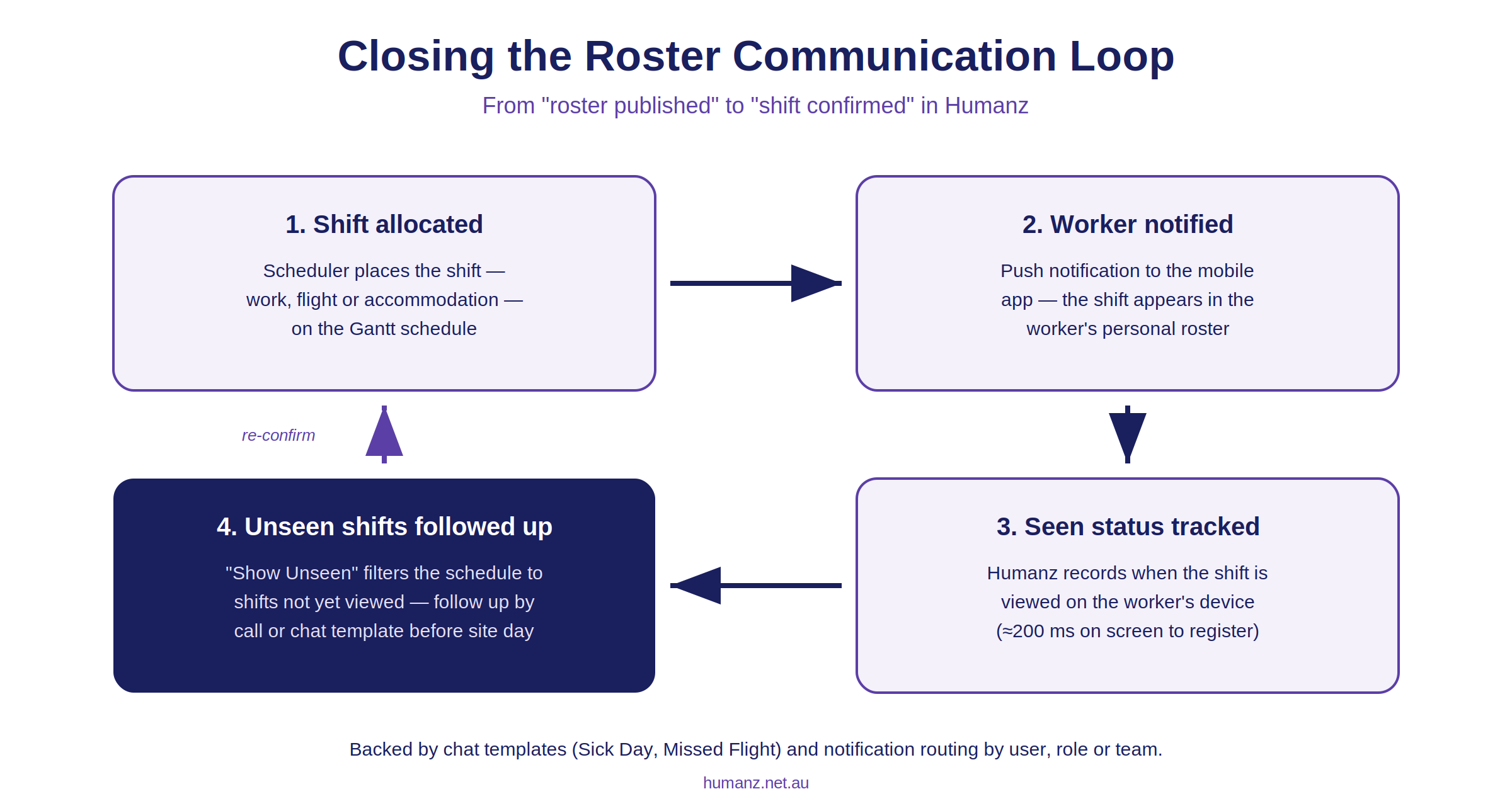
Humanz records whether each allocated shift has actually been viewed by the worker on their mobile app. On the schedule, the Show Unseen button filters the entire Gantt view down to only the shifts workers haven’t seen.
That turns follow-up from guesswork into a two-minute task: switch the filter on, and every shift still showing is a phone call or message you should make before it becomes a gap on site. Switch it back to Show All Shifts when you’re done.
A couple of practical notes from how the feature works:
- A shift needs to be on screen for roughly 200 milliseconds to register as seen — a worker who scrolls past at speed may still show as unseen, so treat it as a conservative indicator.
- The My Organisation page also shows each user’s last login date and time — useful for spotting workers who haven’t opened the app at all.
For rosters with long lead times — FIFO swings, shutdown mobilisations — this is the difference between discovering a problem at the airport and discovering it a week out. It pairs directly with putting flights and accommodation on the roster, since travel shifts get the same seen/unseen visibility.
2. Chat templates — workers always know who to message
In large or rotating teams, remote workers often don’t know who is rostered on in the office today. So they message the person they know — who’s on days off — and the sick call sits unread until 9am.
Chat templates fix this by creating standing group chats aimed at a function, not a person. You build them once in your business profile:
- Create a template (for example Sick Day or Missed Flight)
- Choose who receives it — by individual user, role, team, or any combination
- Activate it, and it appears as a global chat for your workforce
A worker who misses a flight taps the Missed Flight chat and types one message. Everyone currently responsible for handling it sees it immediately — no hunting for names, no single point of failure. For shift-change communication this also supports the practical side of Fair Work obligations around notice of roster changes: changes and responses happen in one traceable channel.
3. Business notification routing — alerts go to the right people
The third leg is making sure the business side notifications — the system alerts your office team relies on — land with the right people. In Business Notifications, each notification type can be routed to specific users, roles, teams, or a combination.
That means the scheduling team gets scheduling alerts, the HR coordinator gets onboarding ones, and nobody learns to ignore a flooded inbox. (Worker-facing notifications are unaffected — this only controls internal routing.)
Clear, targeted communication isn’t just operational hygiene. Consultation and communication are explicit elements of managing WHS risk under Safe Work Australia’s guidance, and industry bodies like Master Builders Australia consistently identify workforce communication as a top driver of project labour problems.
What this looks like in practice
A typical setup for a trades or mining services business using a mobile workforce app for contractors and employees:
- Roster published → workers get push notifications on their phones
- Three days out → scheduler runs Show Unseen, follows up the stragglers
- Worker problem (sick, missed flight, vehicle issue) → worker uses the matching chat template, the rostered office crew responds, the shift is recovered or refilled
- System alerts → routed by role and team so the right person acts on them
Each step removes a place where “nobody told me” can happen. The same confirmation loop matters wherever shifts change at short notice — including rostering for retail, hospitality, and events, where last-minute casual changes are the norm. For businesses comparing platforms, this confirmation-and-escalation loop is a capability worth testing in any workforce management software Australia shortlist — publishing a roster is table stakes; proving it was received is not.
Frequently asked questions
Can workers tell they’re being tracked as seen/unseen? The seen status is a scheduler-side view. Workers simply use their app as normal; the schedule records whether allocated shifts have been displayed on their device.
Is the seen indicator 100% reliable? Treat it as a strong signal, not a guarantee — a shift must display for about 200 milliseconds to register, so very fast scrolling can leave a viewed shift marked unseen. When in doubt, follow up.
Who can be in a chat template? Any combination of individual users, roles, and teams. Membership updates with your org — if the rostered supervisor changes, the role-based chat still reaches whoever holds it.
Do chat templates replace normal one-to-one chat? No — they sit alongside it as global chats for defined scenarios, so workers always have a guaranteed-monitored channel for time-critical issues.
Does notification routing change what field workers receive? No. It only controls which internal users, roles, or teams receive business notifications. Worker notifications are unchanged.
Want fewer “I never saw it” conversations? Book a demo and we’ll show you seen/unseen tracking running on a live roster.
Related articles
Ready to see Humanz on your own roster?
Free 30-minute walkthrough — we'll use your real crews, sites and shift patterns.