
 Login
Login 

Guides
WFM software explained — what it is and why field teams need it
By Humanz · 2026-06-21
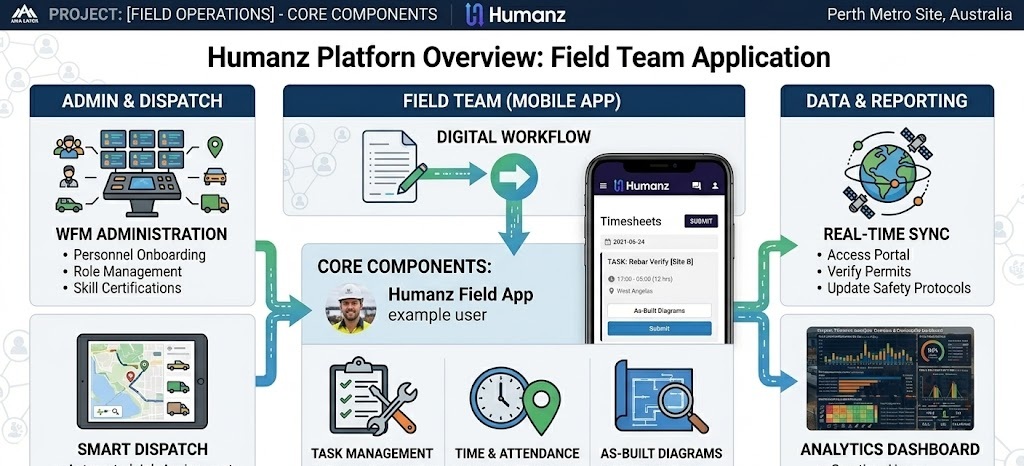
WFM software is a term that gets used broadly and not always consistently. Ask five vendors what their WFM software does and you’ll get five different answers — because workforce management software covers a wide spectrum, from basic shift builders to fully integrated platforms handling scheduling, compliance, timesheets, communication, and asset management in one system.
For Australian businesses with field teams — trades, construction, mining services, or any operation where workers are out on sites rather than in an office — understanding what WFM software actually does, and what it should do, is the starting point for choosing the right platform.
What does WFM software stand for?
WFM software stands for Workforce Management software. It refers to digital tools that help businesses plan, deploy, and manage their workforce — from scheduling shifts and tracking hours to monitoring compliance and managing communication.
The term is used interchangeably with workforce management system (WFM system), workforce management platform, or workforce management application. For practical purposes, these all refer to the same category of tool.
What WFM software actually does
At its core, workforce management software addresses six operational functions:
1. Scheduling and rostering
The most visible function of a WFM system is building and managing rosters. For field businesses, this means:
- Creating shift rosters for individual workers or entire crews across multiple sites
- Managing real-time availability and leave
- Handling last-minute changes and shift swaps with instant mobile notification
- Tracking shift confirmations — knowing who has actually seen and accepted their shift before the morning of work
The operational cost of poor rostering in construction specifically is covered in how real-time rostering reduces no-shows on construction sites — the numbers illustrate why this is worth taking seriously.
2. Time and attendance
WFM software replaces paper timesheets with digital time tracking. Workers clock on and off through the app, timesheets are generated from shift data, and approved hours flow into payroll without manual re-entry.
Australian businesses have a legal obligation here. The Fair Work Act requires employers to keep time and wages records for seven years. Digital timesheets from a WFM system satisfy this automatically. Reducing timesheet errors in the field covers the operational accuracy case — the payroll savings from eliminating manual estimation are significant.
The ATO’s Single Touch Payroll framework also requires payroll events to be reported digitally each pay cycle. Accurate time records from your WFM system are what makes STP compliance straightforward — messy manual timesheets make it a problem.
3. Compliance management
For Australian field businesses, compliance is embedded in every operational decision. A WFM system should surface compliance information at the point where scheduling decisions are made. That means:
- Fatigue monitoring — automatically flagging when a roster pushes a worker beyond safe hour thresholds before the shift is confirmed. Fatigue management software built into the scheduling workflow is the modern standard for mining, transport, and construction.
- Licence and certification tracking — verifying workers hold current, valid qualifications for the work they’re rostered on. Training.gov.au maintains the national register of accredited qualifications — the reference point your system should align with.
- Automated expiry alerts — notifications before licences, tickets, or insurance certificates lapse. Automated compliance through fatigue policies and qualification expiry alerts covers how this works in practice.
- Compliance records for audit — timestamped evidence of compliance checks, roster decisions, and alerts for WHS investigations or principal contractor audits.
Comcare and the broader Safe Work Australia framework make clear that employers must demonstrate active, ongoing management of foreseeable risks — not just a one-time policy document.
4. Communication
WFM software replaces unstructured external communication — WhatsApp groups, SMS chains, phone calls — with structured, job-linked messaging built into the platform. Messages about a specific site go to that site’s crew. Shift notifications go to the relevant worker. Everything is logged with a timestamp.
This matters for compliance as much as for operations. In a WHS investigation, showing that a safety brief was sent, received, and acknowledged is far stronger than a verbal claim. In-app messaging for field teams explains why the distinction between job-linked messaging and a group chat matters more than most businesses initially realise.
5. Workforce analytics and reporting
A WFM system accumulates operational data over time that gives managers visibility they’d never get from a spreadsheet:
- Hours worked by worker, crew, site, or project
- Overtime and penalty rate trends
- No-show rates and shift fill rates
- Compliance status across the workforce
- Asset utilisation and allocation history
The scheduler power tools available in modern WFM platforms — filters, team views, and unallocated-shift reason codes — turn a roster into an operational reporting tool. AIPM publishes project management resources that reflect the value of this kind of workforce data in complex project environments.
6. Documentation and digital forms
WFM software for field operations replaces paper forms with digital equivalents completed on mobile. Prestart checks, safety observations, induction records, incident reports, and sign-off forms are completed in the app, stored with timestamps, and immediately visible to coordinators.
For construction businesses, this is a core component of the construction site compliance checklist approach — systematic, auditable, and far more reliable than paper that can be lost, damaged, or retrospectively completed.
When have you outgrown spreadsheets?
Most field businesses start managing their workforce in Excel. Rosters are built manually, availability tracked in a shared sheet, and compliance documents filed in a folder. This works — until it doesn’t.
The signs you’ve outgrown spreadsheets are operational:
- You’ve had a no-show because someone didn’t see the updated roster — or the updated version wasn’t communicated clearly
- You’ve deployed a worker with an expired ticket — because qualification tracking was manual and something slipped
- Payroll takes two days to process — because someone reconciles paper timesheets against roster records by hand
- A coordinator spends Monday morning calling subbies to check availability — because there’s no live availability view
- You couldn’t answer a compliance audit question quickly — because the records were in a filing cabinet somewhere
- A project mobilisation created chaos — because onboarding multiple workers simultaneously exposed every weakness in the manual system
The Australian Small Business and Family Enterprise Ombudsman has consistently highlighted that digitising operational processes is one of the highest-return investments available to small and medium businesses. If any of the above sounds familiar, the cost of not implementing WFM software is already higher than the cost of the platform.
WFM software for different field industries
Construction
Construction WFM needs are defined by multi-site complexity, mixed workforces, and heavy compliance obligations. The scheduler needs to handle dynamic project timelines, not fixed weekly patterns. See workforce management software for construction — what to look for in 2026 for a detailed breakdown.
State-based compliance adds layers: SafeWork NSW, WorkSafe Victoria, and WorkSafe Queensland each publish construction-specific guidance. A WFM system designed for Australian construction should reflect these requirements.
Mining services
Mining services businesses face the most demanding WFM environment: remote sites, FIFO rosters, 24/7 operations, strict fatigue compliance, and principal contractor compliance checks. DMIRS and the Minerals Council of Australia set the standards. WFM software for mining needs FIFO logistics, extended swing patterns, and high-volume compliance documentation built in.
Mechanical and trade contracting
Trade contractors — diesel fitters, electricians, plumbers, mechanical engineers — work across varied client sites with varying shift patterns and compliance requirements. Master Electricians Australia and the National Electrical and Communications Association publish compliance guidance for their sectors. WFM software for trades needs mobile-first functionality, strong licence tracking, and the ability to manage both employees and subcontractors.
Field services and utilities
Field service businesses deploy technicians across a geographic region with dynamic daily scheduling. WFM software needs strong real-time scheduling, mobile functionality for workers constantly moving between jobs, and digital timesheet submission that eliminates the end-of-day paper rush.
What to look for when evaluating WFM software
For Australian field businesses, the criteria that matter most:
- Full mobile functionality — not a companion app, a complete mobile experience
- Compliance integration — fatigue monitoring and licence tracking built into scheduling, not managed separately
- All worker types — employees and subcontractors managed from the same platform
- Australian compliance design — Fair Work, WHS, and state licencing reflected in the platform’s design
- Real-time scheduling — live availability and fast roster change workflows
- Digital forms on mobile — for prestart checks, inductions, and incident reports
- Reporting depth — genuine operational visibility, not just a roster view
- Ease of use on mobile — workers in the field won’t use complicated software
How Humanz delivers WFM software for Australian field teams
Humanz is an Australian-built WFM system designed specifically for trades, construction, mining services, and field services. Every feature reflects the operational requirements of field-based teams.
Humanz covers all six WFM functions in a single workforce management platform:
- Scheduling — real-time multi-site rostering with live availability, confirmation tracking, and instant mobile notifications
- Time and attendance — automated digital timesheets from roster data, submitted and approved on mobile
- Compliance — fatigue monitoring, licence tracking, automated expiry alerts, induction management
- Communication — job-linked in-app messaging, shift notifications, pre-built message templates
- Analytics — workforce reporting, compliance dashboards, shift fill rates, and unallocated work tracking
- Documentation — digital forms completed on mobile, timestamped, accessible immediately
Humanz also handles subcontractor management, asset tracking, FIFO travel, and worker onboarding — the full scope of what field businesses need.
See how Humanz works for your team →
Frequently asked questions
Is WFM software the same as HR software? They overlap but aren’t the same. HR software handles employment lifecycle, payroll, and performance management. WFM software focuses on operational scheduling, time tracking, and day-to-day workforce coordination. Many businesses use both — WFM for operations, HR for employment management. Humanz covers the operational and compliance dimensions of both.
What’s the difference between a WFM system and a rostering app? A rostering app schedules shifts. A WFM system does that plus timesheets, compliance, communication, documentation, and analytics. For simple businesses with stable patterns, a rostering app may be sufficient. For field businesses with compliance-heavy operations, a full WFM system delivers significantly more value.
How long does it take to implement WFM software? Most Humanz customers are operationally live within days to a couple of weeks. The main tasks are importing worker data, setting up sites and projects, and configuring roster templates and compliance rules.
Can WFM software replace payroll software? Generally no — WFM software generates the time and attendance data that feeds into payroll, but payroll processing (tax calculations, superannuation, pay slips) is handled by a dedicated payroll system. Humanz integrates with payroll systems to provide a clean, verified data feed.
Is WFM software suitable for small businesses? Yes. A ten-person trade contracting business running callout work has just as much to gain from digital timesheets, licence tracking, and structured communication as a 200-person mining services contractor. See workforce management for startups and small businesses for how smaller field teams get value from a WFM platform, and Fair Work compliance for shift workers for a sense of the obligations that apply regardless of business size.
What does WFM software cost?Get in touch with the Humanz team to discuss pricing based on your specific setup and workforce size.
Trying to work out if WFM software is right for your team? Book a demo and we’ll walk through your current setup and show you exactly where a platform like Humanz would make a difference.
Related articles
Ready to see Humanz on your own roster?
Free 30-minute walkthrough — we'll use your real crews, sites and shift patterns.