
 Login
Login 

Industries
Workforce Management Software for Manufacturing: Rostering, Compliance and Shift Control
By Humanz · 2026-06-22

Running a manufacturing operation means keeping the line moving. Whether you operate a single-shift assembly plant or a continuous 24/7 process facility, the difference between a productive day and an expensive one often comes down to whether the right people, with the right skills, turned up to the right station at the right time. When a shift is short-staffed or a critical competency is missing, you either run slower, run unsafely, or don’t run at all.
Most manufacturers still manage this with a patchwork of spreadsheets, group chats and whiteboards. That works until it doesn’t — until a no-show during night shift leaves a machine unattended, a casual is rostered without the licence to operate it, or a fortnight of timesheets has to be reconciled by hand before payroll closes. This guide covers what manufacturing workforce management software needs to do, how it applies to production environments specifically, and where a platform built for field and shift-based teams fits.
Why manufacturing rostering is harder than it looks
On paper, a manufacturing roster looks simple: fixed shifts, fixed stations, a stable workforce. In practice it rarely stays that way. Demand fluctuates, machines go down for maintenance, people call in sick, and seasonal peaks pull in labour hire to cover the gap. The roster you published on Monday seldom survives the week unchanged.
The core challenge is that production is unforgiving of gaps. A retail store that’s one person short can absorb it. A production line that’s one operator short on a constrained station may have to slow or stop the whole line. That makes shift scheduling for manufacturing a coverage problem first and an admin problem second — you need to see, at a glance, whether every shift across every line is fully and correctly staffed before it starts.
If you’re new to the category and want the fundamentals before going deeper, our plain-English explainer of workforce management software is a good starting point. For the rostering mechanics specifically, see how rostering software works for Australian teams.
Multi-shift and continuous production rostering
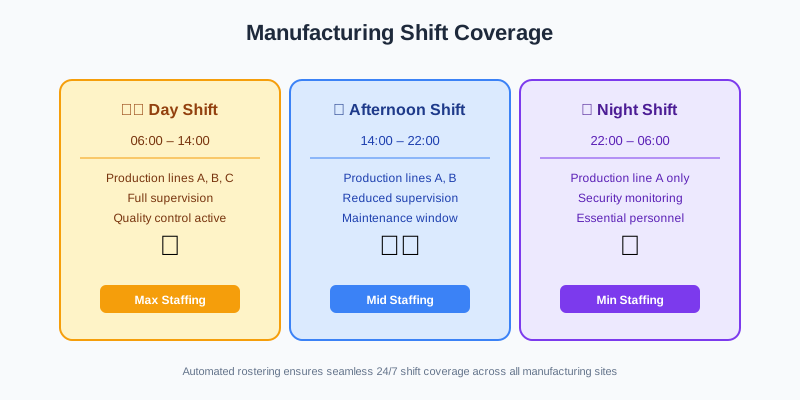
Manufacturing schedules come in many shapes — single day shift, two-shift (day and afternoon), three-shift continuous, and rotating panama or DuPont patterns for 24/7 process plants. Whatever the pattern, manufacturing rostering software needs to handle the same things well:
- Rolling, repeating patterns so you’re not rebuilding the roster from scratch every cycle.
- Real-time visibility across all lines and sites so a regional or multi-plant operation can see coverage in one place rather than chasing each supervisor.
- Fast reallocation when a machine goes down or demand shifts, moving people between stations or lines without losing track of who is where.
- Confirmation tracking so you know in advance whether rostered workers have actually acknowledged their shifts.
That last point matters more than most plant managers expect. A roster is only useful if people show up. Real-time confirmation — workers accepting shifts from their phone, with supervisors notified the moment a shift is declined or unanswered — turns the roster from a hopeful plan into a reliable one. We cover how real-time rostering cuts no-shows on the floor in practice, while the shift confirmation and team messaging side handles the communication that keeps a crew in the loop.
Shift handovers
Continuous operations live and die on the handover. When afternoon shift hands to night shift, the outgoing crew needs to pass on machine status, quality issues, outstanding maintenance and any safety concerns. Done badly — or verbally, with nothing recorded — handovers are where defects and incidents slip through.
Digital custom forms make handovers consistent and auditable. A structured shift-handover form, completed on a phone or tablet at the end of each shift and visible to the incoming crew, ensures nothing critical gets lost between teams. The same approach works for pre-start checks, line clearances and quality sign-offs, with timestamps and a retained record for every one.
Skills, competency and licence matching
Not every operator can run every machine. Forklift licences, high-risk work licences, confined-space tickets, machine-specific competencies and site inductions all determine who can safely and legally be placed where. Rostering someone onto a station they’re not certified for is both a productivity risk and a compliance breach.
Production workforce compliance depends on the roster knowing what each worker is qualified to do — and refusing to schedule them where they’re not. The strongest platforms hold a credential profile for every worker, track expiry dates, and alert you well before a licence, ticket or induction lapses. Better still, compliance gates can prevent an uncredentialed or expired worker from being rostered onto a restricted task in the first place, so the control is enforced rather than relying on a supervisor to remember.
For a deeper look at how this should work, our upcoming guide explains keeping tickets, inductions and competencies current. The principle is simple: the roster should make it hard to do the wrong thing, not just easy to do the right thing.
Fatigue and safety on the production line
Shift work, night work and overtime are facts of life in manufacturing — and all three are fatigue risks. Fatigue degrades reaction time, judgement and attention, which around moving machinery and heavy plant is a serious safety hazard. It’s also a managed risk under Australian work health and safety law.
Safe Work Australia’s fatigue guidance is clear that managing fatigue is a duty under the WHS framework, and that work scheduling — shift length, rotation, rest breaks and consecutive shifts — is a primary control. That puts the roster at the centre of fatigue management. If your scheduling system can’t see how many consecutive shifts or cumulative hours a worker has accrued, it can’t help you manage the risk.
Fatigue monitoring built into the roster changes that. The system can track cumulative hours and consecutive shifts, flag when a worker is approaching an unsafe threshold, and warn before you roster someone onto back-to-back nights or excessive overtime. Our detailed look at fatigue management software for Australian operations explains what a proper fatigue risk management approach looks like and how it connects to scheduling.
Casual, labour-hire and seasonal pools
Few manufacturers run on permanent staff alone. Seasonal peaks, large orders and absence cover are usually filled with casuals and labour hire — and managing a flexible pool well is its own discipline.
The practical problems are familiar: who in the pool is available this week, who is already inducted and credentialed for your site, who has worked the relevant line before, and how do you fill an open shift quickly without ringing around. A workforce platform that holds your casual and labour-hire pool in the same system as your permanent crew lets you fill gaps from a known, pre-qualified group rather than starting from scratch each time. Subcontractor and labour-hire workers can be onboarded once, with their credentials tracked the same way as direct employees, so a casual is never placed on a shift they’re not cleared for.
This is the same capability set that field-services and construction operators rely on for contractor-heavy workforces — managing mixed employee and contracted labour in one place, with consistent compliance across both.
Timesheets and payroll accuracy
Manufacturing pay is rarely flat. Shift loadings, overtime, weekend and public holiday penalties, and allowances all flow from what was actually worked — and getting it wrong is both a cost and a compliance exposure under the relevant modern award. The Fair Work Ombudsman sets out employer record-keeping and pay obligations, including the requirement to keep accurate time and wage records — and the regulator expects those records to stand up to scrutiny.
The accuracy problem usually starts at data entry. When timesheets are filled in from memory at the end of a fortnight, or transcribed from paper into a spreadsheet and then into payroll, errors compound at every step. The fix is to start the timesheet from the source of truth — the roster.
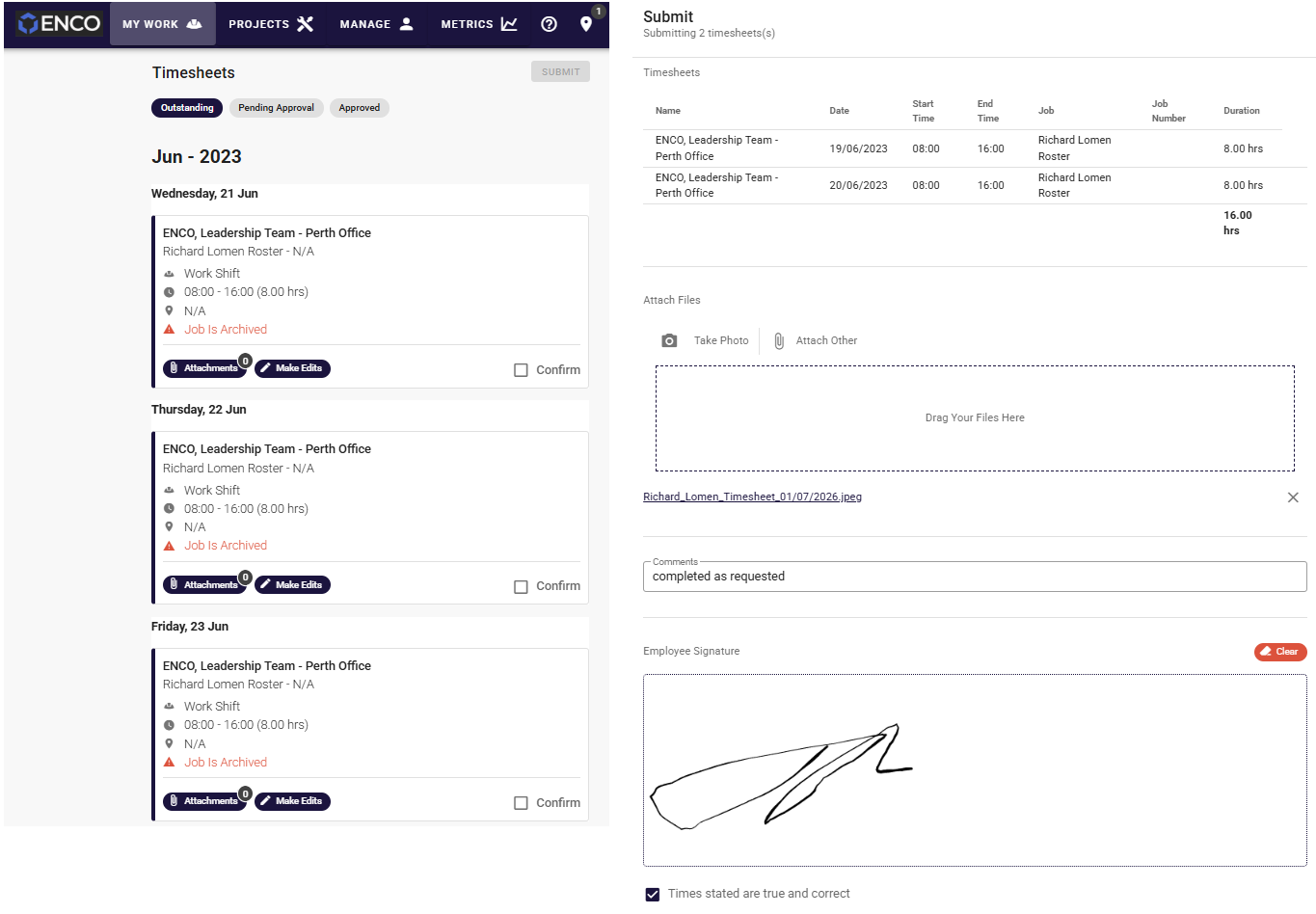
Roster-prefilled digital timesheets capture planned hours automatically, let supervisors confirm or adjust actuals against them, and produce an audit trail of who approved what and when. That gives you clean, defensible records and a far smoother path into payroll, with less manual re-keying and fewer disputes. Our walkthrough of how digital timesheets actually work covers the workflow, and our upcoming article on feeding roster data straight into payroll looks at how that data flows downstream. For the record-keeping side specifically, our piece on meeting Fair Work obligations for shift workers goes deeper.
Downtime, coverage and workforce analytics
You can’t improve what you can’t measure. Once rostering, confirmations and timesheets are in one system, the data they generate becomes genuinely useful for managing manufacturing labour scheduling in Australia at a strategic level.
The metrics that matter most for production teams include:
- Coverage and fill rates — how often shifts run fully staffed versus short, and which lines or shifts are chronically hard to cover.
- No-show and late-confirmation rates — early warning of reliability problems before they hit the line.
- Overtime and labour cost trends — where overtime is being relied on to plug structural gaps.
- Skills coverage — whether you have enough certified operators for each critical station, or a single point of failure waiting to happen.
Surfacing these in a dashboard turns workforce data into decisions — about hiring, cross-training, shift design and where to grow your casual pool. Our guide to turning workforce data into operational decisions explores the metrics worth tracking and how to act on them.
How Humanz helps manufacturing teams
Humanz is an Australian-built workforce management platform, founded in 2019 and now used by more than 80 companies across construction, mechanical contracting, mining services, drilling and trades. Those are shift-based, compliance-heavy, equipment-driven operations — the same operating reality as a production floor, where coverage on a constrained station and a current ticket for the operator standing at it both decide whether the line runs.
In a manufacturing setting that translates into a few things working together. Real-time rostering shows coverage across every line and plant in one view, with rolling day, afternoon and night patterns you build once and reuse rather than rebuilding each cycle. Shift confirmations tell you before the shift starts whether your operators have actually accepted, so a night-shift gap surfaces while there’s still time to fill it. Credential profiles hold each worker’s forklift licence, high-risk work tickets, machine competencies and site inductions, with expiry alerts and compliance gates that simply won’t let an uncredentialed or lapsed worker be rostered onto a restricted machine. Fatigue logic tracks cumulative hours and consecutive shifts and warns before you put someone on back-to-back nights. Your casual and labour-hire pool sits in the same system as your permanent crew, credentialed once and drawn on when a large order or seasonal peak hits. Custom forms turn shift handovers, pre-starts, line clearances and quality sign-offs into timestamped, auditable records. And roster-prefilled timesheets carry planned hours straight through supervisor approval into payroll, with the in-app messaging, mobile app and coverage-and-overtime analytics that keep the floor connected and the numbers honest.
To be straight about one thing: Humanz does not have AI features in the product today. Automated, demand-driven scheduling is on the roadmap rather than available now, and we’d rather say so than oversell it. What you get today is dependable real-time rostering with the compliance, fatigue and timesheet controls a production environment actually needs. You can read more about how we build for field and shift-based teams.
If your production rosters currently live across spreadsheets, group chats and paper timesheets, pulling them into one platform is usually the fastest way to cut admin time and tighten compliance at once.
Running multi-shift lines where a missing ticket or a tired operator can stop the whole floor? Book a Humanz demo and bring a roster from your busiest week — we’ll map your shift patterns, competency gates and fatigue rules live.
Frequently asked questions
What is manufacturing workforce management software?
It’s a platform that handles the operational side of managing a production workforce — rostering and shift scheduling, confirmation tracking, skills and licence matching, fatigue monitoring, timesheets and compliance — in one system. It differs from HR software, which focuses on the employment lifecycle (contracts, leave, performance). Manufacturers usually feel the workforce management need most acutely, because coverage and compliance directly affect whether the line runs.
Can it handle continuous 24/7 and rotating shift patterns?
Yes. Good manufacturing rostering software supports rolling, repeating shift patterns — including two- and three-shift operations and rotating panama or DuPont rosters — so you build the pattern once and reuse it, rather than rebuilding each cycle. It should also let you reallocate people quickly when a machine goes down or demand shifts.
How does the software help with safety and fatigue on the production line?
By bringing fatigue into the roster itself. The system tracks cumulative hours and consecutive shifts and warns before a worker crosses an unsafe threshold, helping you manage fatigue as the WHS control it is. Because the regulator treats work scheduling as a primary fatigue control, keeping that logic in the rostering tool rather than in someone’s head is the practical way to meet the obligation.
How does it keep us compliant with licences and inductions?
Each worker has a credential profile with licences, tickets, competencies and inductions, plus their expiry dates. The system alerts you before anything lapses, and compliance gates can prevent an uncredentialed or expired worker from being rostered onto a restricted machine or task — so the control is enforced rather than relying on memory.
Does it improve timesheet and payroll accuracy?
Significantly. Timesheets prefilled from the roster start with the planned hours already captured, so supervisors confirm or adjust actuals rather than entering everything from scratch. That reduces transcription errors, creates an audit trail of approvals, and gives payroll clean, defensible records aligned to the relevant award.
Can it manage casual and labour-hire workers alongside permanent staff?
Yes. A flexible pool of casuals and labour hire can be onboarded and credentialed once, then held in the same system as your permanent crew. When you need to fill a shift, you draw from a known, pre-qualified group, and the same compliance rules apply to everyone — so a casual is never placed on a task they aren’t cleared for.
Does Humanz use AI to build the roster?
Not today. Humanz does not currently have AI features in the product — automated scheduling is on the roadmap rather than available now. What Humanz provides today is real-time manual rostering with confirmation tracking, compliance gates, fatigue monitoring and analytics, built specifically for Australian shift-based teams.
Related articles
Ready to see Humanz on your own roster?
Free 30-minute walkthrough — we'll use your real crews, sites and shift patterns.